
An Indigenous Language Dies Every Two Weeks
June 25, 2026
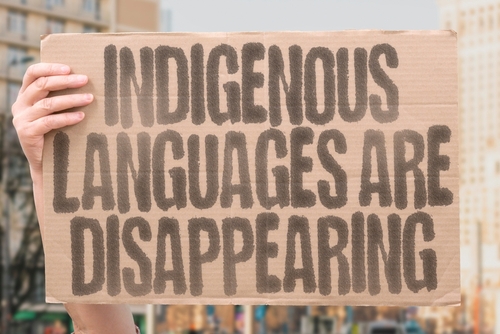
Conservative estimates from the United Nations support earlier findings published by the Harvard International Review that indigenous languages are disappearing at an alarming rate and more than half of the world’s existing languages may become extinct by 2100. Shockingly, although indigenous people make up less than 6% of the world’s population, they do speak more than 4,000 languages. Plus, up to 96% of the 6,700 languages spoken globally are only spoken by as little as three-percent of the world’s population and mostly in tribal situations.
Linguists suggest that so many methods of communication face threat of extinction today because globalization was directly related to this overwhelming era of colonialism that led to the development of more complex systems of human-to-human communications. Since this was simultaneously happening in every nook and cranny, the identity of indigenous people, their languages, and the preservation of their cultural views faced the threat of extinction as native languages were no longer being taught the same way to children by their parents.
Without doubt, global colonial practices included assimilation policies designed to encourage individuals from minority or indigenous backgrounds to adopt the culture, norms, languages and values of the more dominant society at the expense of losing their own cultural identity through the dismantling of communal land ownership and tribal structure, as well as the banning of traditional spiritual and cultural practices by establishing legal mandates. By the early 20th-century, an “Americanization” movement saw sociologists begin to condemn forced assimilation that marginalized communities and violated long-term human rights.
What was Article 13 on the Rights of Indigenous People?
In 2007, under Article 13.1 of the United Nations Declaration on the Rights of Indigenous People, future generations of native inhabitants were guaranteed the right to revitalization and use of their native tongues, and the transmission of histories, languages, oral traditions, philosophies, and writing systems, as well as the right to retain the names of communities, persons, and places. Nine years later, a historic human rights framework adopted by the Organization of American States was enacted as the American Declaration on the Rights of Indigenous People to protect gender equality, cultural identity, and self-determination of over 50 million indigenous people residing across North America (including Central America and the Caribbean) and South America. Today, legal representatives of indigenous groups use these documents to advocate for international ownership of land and the legal protection of their natural resources.
Revitalizing Indigenous Languages in the Americas
Where the globalization of the Americas collectively cover over eight percent of the Earth’s surface and are home to 35 sovereign states with a total population that exceeds over one billion people. The largest countries by land mass are Canada, the United States and Brazil with major populations living in the cities of São Paulo, Lima, Mexico City, and New York City. This two-continent model is dominated by English, Spanish, Portuguese, and French languages. However, over 1,000 distinct indigenous languages are still spoken today and some hold official status, such as:
- Navajo: This indigenous language (Diné Bizaad) is spoken by 160,000 to 170,000 people primarily residing in the U.S. Southwest, which makes it the most widely spoken Indigenous language north of Mexico.
- Mayan: Spoken by over a million people in Guatemala and Mexico, Q?eqchi? and K?iche? are part of a massive family of 32 living indigenous languages used by Mayan people across Mesoamerica and Mexico.
- Nahuatl: A Uto-Aztecan language that is spoken by roughly 1.7 million people, predominantly in Central Mexico. Nahuatl spans 5,000 years as the language of the Aztec Empire and contributed many everyday words to English.
- Quechua: This indigenous language of the South American Andes is spoken by roughly 10 million people across Peru, Bolivia, Ecuador, Colombia, Chile, and Argentina. It was the primary language of the Inca Empire.
- Guarani: Spoken by approximately 9 million people in Paraguay, as well as parts of Argentina, Brazil, and Boliva, it is one of the few indigenous language in the Americas that is spoken by a large population of non-indigenous peoples.
While the speaking populations of some indigenous languages of the Americas is still quite large, linguists today classify each of these as an endangered language. Even though there are ongoing revitalization efforts, academic initiatives, and community revitalization programs working to preserve them, many families have simply stopped passing language down to younger generations in favor of Spanish, which does not come with a negative historical stigma or cultural discrimination. Although no modern dialect of Nahuatl matches that spoken by the Aztecs, it is recognized as an official national language of Mexico.
United Nations Permanent Forum on Indigenous Issues
For decades, the United Nations Permanent Forum on Indigenous Issues has been raising the alarm about the threats facing indigenous languages globally. The Forum initially called on governments to introduce indigenous languages back into public administration across many indigenous territories. It also urged UN country offices to publish activities using indigenous languages. Over time, the Forum has encouraged UNESCO to get behind an initiative for indigenous language and cultural studies centers to be established in universities.
Despite the challenges, some indigenous communities have found success in language revitalization. Native Hawaiians championed Hawaiian language education in public schools where a student’s entire curriculum is taught in Hawaiian. This was a remarkable turnaround for a language that was on the brink of extinction before being re-established as an official language of the State of Hawaii. Similarly, the people of Kamchatka (Russia) benefited from a combination of government programs and community-driven initiatives, where locals shared indigenous language songs through online platforms and smartphone apps.
Nonetheless, many communities across the global village are still fighting an uphill battle. While most governments have introduced some form of legislation or policy to address their indigenous language crisis, these measures often fall short. In Chile, for instance, legislation protects nine indigenous languages on paper, however, only four are permitted to be taught in schools, and only in areas where indigenous students make up more than 20% of the student population. For the many indigenous Chileans living in urban areas, this leaves their native languages without formal protection.
_______________________
The stakes could not be higher. Sustained multilingual education and language revitalization programs offer a path forward, but they are chronically underfunded. Too often, available resources are directed toward recording and documenting languages, rather than creating true revitalization programs that are indeed needed to keep those unique languages alive and thriving. Although the global movement toward multilingualism is reshaping the way we communicate, English is expected to remain a dominant language for international communication in the foreseeable future. But, in today’s digital world, organizations who want to remain at the forefront of global online sales must embrace unique multilingual opportunities to make potential customers feel more included, as it is an important part of an international business’s brand. To learn more about ProLingo’s translation and multi-lingual interpretation services, contact a digital language specialist today at 800-287-9755.


